In 2010, I got my first web job at a local WordPress shop, building child themes. I can tell you what a child theme is now. Back then I had no idea.
A friend invited me to a WordPress meetup. I showed up expecting to have somebody to sit with, and they bailed at the last minute. I was already there, so sneaking out wasn’t an option anymore. I got my laptop out and sat down at a table by myself.
The first part of the meetup was set aside for people who needed help with their WordPress questions. A friendly face sat down next to me and asked if I needed any help. I asked about child themes, and he pointed me in the right direction.
That was Chris. More than fifteen years later, I’m still here and still contributing because he sat down and said hi.
We’re Not So Different, You and I
Every WordPress person has some version of this story. They had a need, WordPress turned out to be the answer, and somebody helped them with the part they couldn’t figure out alone.
Under normal circumstances, none of us would have crossed paths. We don’t live in the same places, we didn’t go to the same schools, and most of us don’t do the same work. WordPress is the only reason we know each other at all. It isn’t an industry. It’s a congregation of people who volunteered for the same responsibility.
Generosity Is the Prerequisite
Nobody assigned Chris to help me that night. He had no obligation to help me; just a genuine willingness to help. He explained child themes the way you’d explain them to someone who was definitely going to build one, which at the time was generous to the point of being inaccurate. He knew a thing, I didn’t, and in this community that turns out to be the entire prerequisite.
I saw Chris around for years after that, but we didn’t have a real conversation until 2014, and it happened because of a fire drill in a building two thousand miles away. We were at a WordCamp San Francisco watch party in St. Louis. At the event in San Francisco, an alarm went off and everyone had to evacuate the building. The livestream went dead. So there we were, a room full of people who’d come for the talks, with no talks. We talked to each other instead.
I’ve thought about that day a lot in the years since. The fire drill wrecked the schedule, and without it I don’t know that Chris and I would have ever really gotten to know each other. That was the day he talked me into joining the WordCamp St. Louis 2015 organizing team. I wasn’t qualified to plan a WordCamp. As it turns out, nobody checks. That’s the part that’s hard to explain to people who haven’t contributed to open source before; there’s no gate, no approval, nobody whose job is deciding when you’re ready. You’re ready when you see the work and pick it up.
What makes you an open source contributor was never skill or experience. It’s generosity; the willingness to put time and effort into something bigger than you.
Everyone Pitches In
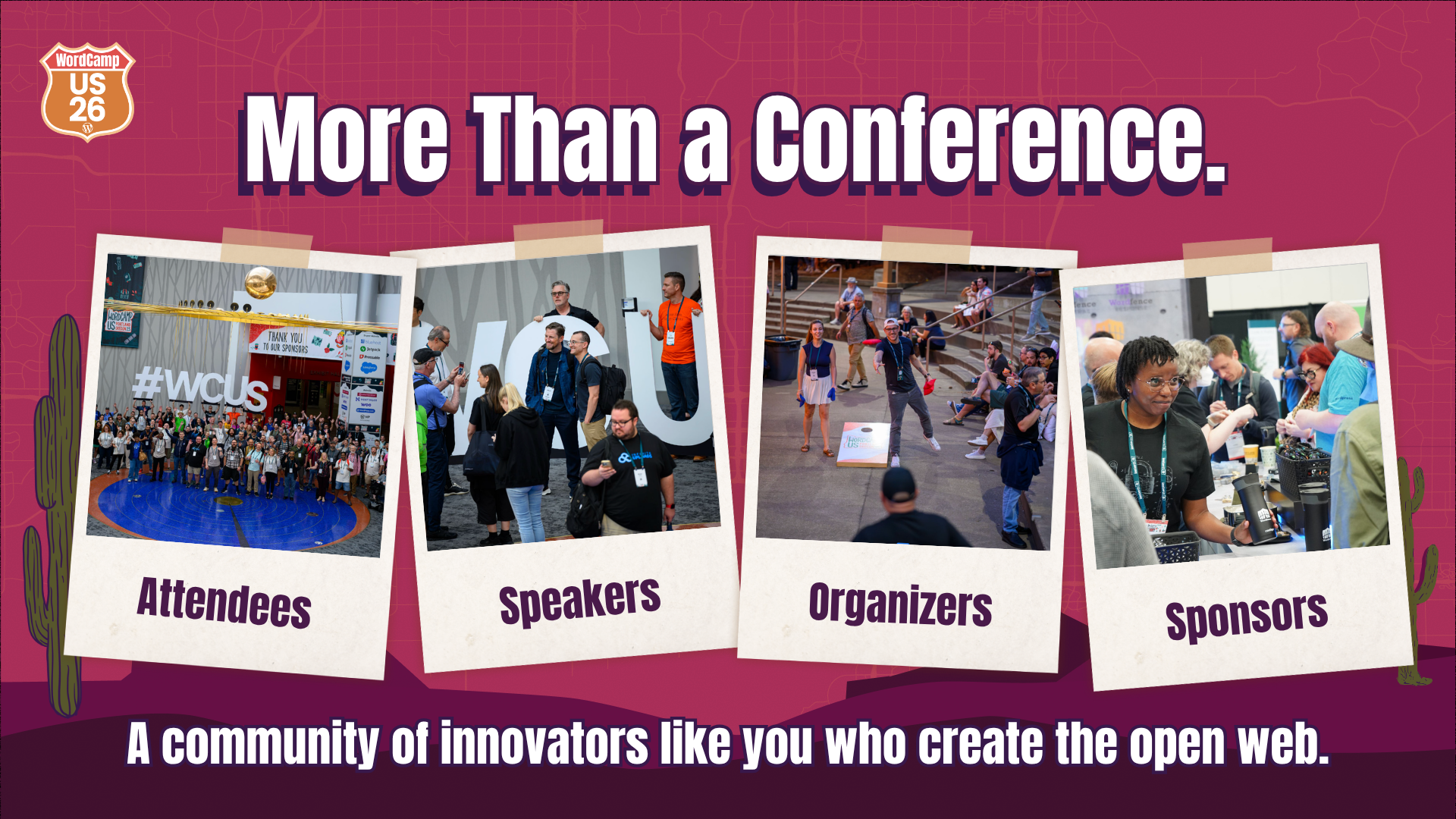
The person on stage right now was wiping down tables this morning. That speaker is someone else’s mentee. The people helping at the Happiness Bar gave up a session they wanted to see so a stranger could have the same aha moment they had a few years ago. At least one organizer took PTO from a job that has nothing to do with WordPress in order to be here.
There are opportunities to contribute all week. Some of them are literal, at Contributor Day. Most of them are just small acts of kindness in the halls of a convention center. Lending a hand to someone who needs one counts as much as a line of code. Both things sustain us.
Invisible Until It Breaks
Organizing a WordCamp comes with a long list of thankless jobs, and the most thankless of all is dealing with the venue. Somebody arranged the space, the furniture, the food, and figured out how much coffee two hundred people drink before noon. I have never once heard that person thanked from a stage, and I’ve helped organize almost a dozen of these events, so I’ve had plenty of chances to notice.
You don’t notice either, and that’s not a criticism; it’s by design. Nobody walks into a room and thinks about the room. You think about the room only when something isn’t the way you expected it to be.
I sat down to make a list of the people who’ve helped me get here and I couldn’t finish it. I couldn’t even come up with most of their names. That isn’t a failure of memory. Invisible work is invisible; that’s the deal. Forty percent of the web runs on the labor of people I cannot name and will never meet.
The first time I came to a WordCamp US Contributor Day, I didn’t know where to sit. I ended up at the Community table and spent the day updating documentation, which is about as unglamorous as contributing gets. Parts of those changes are still there today. If they weren’t, you’d notice.
Somebody Believed It Before I Did
I didn’t say yes to organizing a WordCamp because I had the skills. I said yes because someone invited me to come along. I didn’t believe I could do it. Chris did. Now I’m the one saying it to other people.
That’s the actual mechanism keeping this project alive. Not governance or funding; people believing in each other slightly ahead of the evidence.
The Only Thing I’m Going to Ask
At some point this week, somebody will be standing somewhere by themselves. Don’t let them linger. Invite them in.
At WordCamp US, nobody is just an attendee. Not even you. Contributing to open source can start with simply saying hello.